
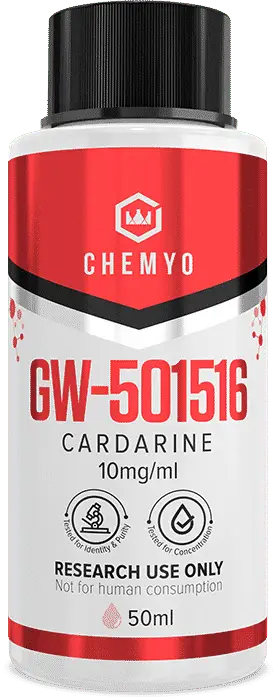

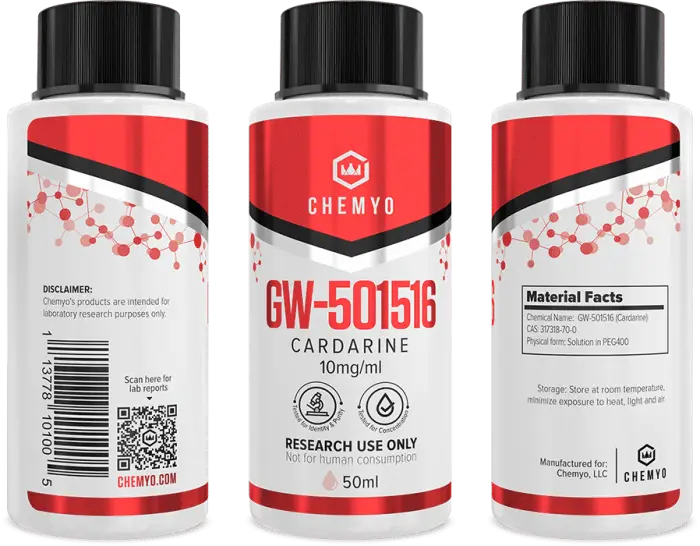

GW501516 | Cardarine Solution 10mg/ml – 50ml
| Application | A selective and potent PPARβ agonist |
| Concentration | 1% (10mg/ml) |
| Composition | 94% PEG 400, 5% Ethanol, 1% GW-501516 (>99% purity) |
| CAS | 317318-70-0 |
| Molar Mass | 453.50 g/mol |
| Chemical Formula | C21H18F3NO3S2 |
| Synonyms | Cardarine, Endurobol, GSK-516 |
| Storage | Minimize open air exposure, store in a cool dry place |
| Terms | For laboratory research use only. Not for human or animal consumption. |
What Is GW501516 (Cardarine)?
GW501516, also known as Cardarine or Endurobol, is a potent synthetic PPARδ (peroxisome proliferator-activated receptor delta) agonist developed by GlaxoSmithKline and Ligand Pharmaceuticals. It activates PPARδ — a nuclear transcription factor expressed in skeletal muscle, heart, liver, and adipose tissue — triggering a cascade that upregulates fatty acid oxidation genes and shifts substrate utilization toward fat in skeletal muscle. The resulting effect in animal models is a profound improvement in endurance capacity and lipid metabolism without additional exercise training.
Clinical development was discontinued in 2007 after multi-dose carcinogenicity studies in rodents showed rapid tumor formation across multiple tissue types. Despite this, GW501516 remains one of the most widely used tool compounds in metabolic biology research due to its potency, selectivity, and well-characterized dose-response profile in cell-based and animal models.
Mechanism: PPARδ Activation and Fatty Acid Oxidation
PPARδ activation by GW501516 upregulates the expression of genes in the fatty acid catabolism pathway — including PDHK4, CPT1, ABCA1, and UCP3. This increases mitochondrial fatty acid import and oxidation in skeletal muscle while simultaneously upregulating HDL biogenesis in the liver. The net effect is improved metabolic flexibility, elevated HDL cholesterol, reduced triglycerides, and enhanced exercise endurance — all reproducibly demonstrated in rodent treadmill models.
Research Applications
- Fatty acid metabolism: PPARδ pathway activation studies in muscle, liver, and adipose tissue.
- Endurance physiology: Rodent treadmill models examining exercise capacity without training stimulus.
- Lipid research: HDL elevation, reverse cholesterol transport, and triglyceride reduction studies.
- Metabolic disease models: Obesity, dyslipidemia, and insulin resistance research designs.
Related Research Compounds
GW501516 is frequently studied alongside SR9009 (Stenabolic) and SR9011 — both Rev-ErbA agonists that improve metabolic endpoints through distinct mechanisms. For anabolic/metabolic combination designs, Ostarine, RAD-140, or MK-677 are commonly added. For a higher-selectivity PPARδ agonist alternative, see GW0742. Also available: Cardarine GW-501516 Powder (1g).
Read our full guide: GW501516 (Cardarine) Research Guide: PPARδ Activation, Endurance & Safety.
⚠ Safety note: GW501516 is associated with carcinogenicity findings in rodent studies and must be handled with appropriate laboratory precautions. For laboratory research use only.








Reviews
There are no reviews yet.