


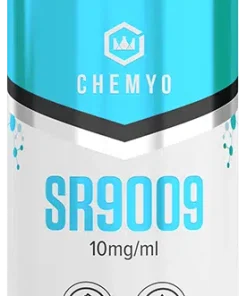

SR9009 Solution 10mg/ml – 50ml
| Application | Agonist of Rev-ErbA |
| Concentration | 1% (10mg/ml) |
| Composition | PEG400, 1% SR9009 (>99% purity) |
| CAS | 1379686-30-2 |
| Molar Mass | 437.94 g/mol |
| Synonyms | Stenabolic |
| Storage | Minimize open air exposure, store in a cool dry place |
| Terms | For laboratory research use only. Not for human or animal consumption. |
What Is SR9009 (Stenabolic)?
SR9009, commonly referred to as Stenabolic, is a synthetic Rev-Erbα/β agonist developed at the Scripps Research Institute. By binding and activating Rev-Erb nuclear receptors, SR9009 modulates the expression of genes governing circadian rhythm, lipid and glucose metabolism, inflammatory signaling, and mitochondrial biogenesis. A landmark 2013 paper in Nature demonstrated that SR9009 treatment in mice increased mitochondrial content in muscle, reduced body fat and plasma triglycerides, and dramatically improved treadmill running capacity — all without changes in food intake — generating intense scientific interest in the compound’s metabolic biology applications.
Mechanism: Rev-ErbA and the Metabolic Clock
Rev-Erbα and Rev-Erbβ are heme-binding nuclear receptors that repress the transcription of clock genes (BMAL1) and lipogenic genes by recruiting the NCoR/HDAC3 co-repressor complex. SR9009 enhances this repressive activity, effectively silencing fat storage gene programs while upregulating mitochondrial biogenesis in skeletal muscle. The net result is a profound shift toward fatty acid oxidation as the primary metabolic substrate — producing the “exercise mimetic” effects observed in rodent models.
Research Applications
- Metabolic disease: Obesity, dyslipidemia, and insulin resistance models respond to SR9009-mediated Rev-Erb activation.
- Circadian biology: Rev-Erb receptors are master regulators of the circadian clock; SR9009 is a primary tool for their experimental manipulation.
- Endurance physiology: Increased mitochondrial density and fatty acid utilization in muscle improve exercise capacity in rodent models.
- Cancer biology: Rev-Erb receptors modulate cell cycle progression; SR9009 has shown antiproliferative effects in certain cancer cell lines.
SR9009 vs Related Metabolic Compounds
SR9009 is mechanistically distinct from PPARδ agonists like GW501516 (Cardarine) and GW0742 — which activate fatty acid oxidation through transcription factor programs, while SR9009 works through the circadian/Rev-Erb pathway. Its close analog SR9011 offers higher CNS penetration for studies with a neurological or anxiety component. For anabolic/metabolic combination designs, Ostarine or RAD-140 are frequently added.
Also available: SR9009 Powder (1g). Read our guide: SR9009 Research Guide: Rev-ErbA Mechanism & Metabolic Effects.
For laboratory research use only.








Reviews
There are no reviews yet.