
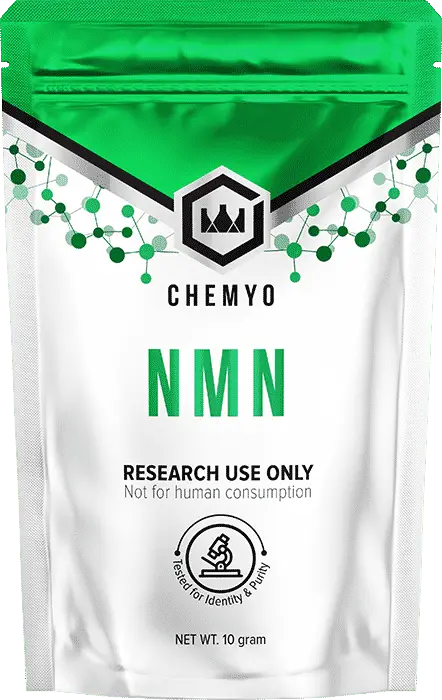
Nicotinamide Mononucleotide Powder – 10g
| Application | NAD+ precursor / Sirtuin activator |
| Purity | >99% (third-party verified) |
| Amount | 10 grams |
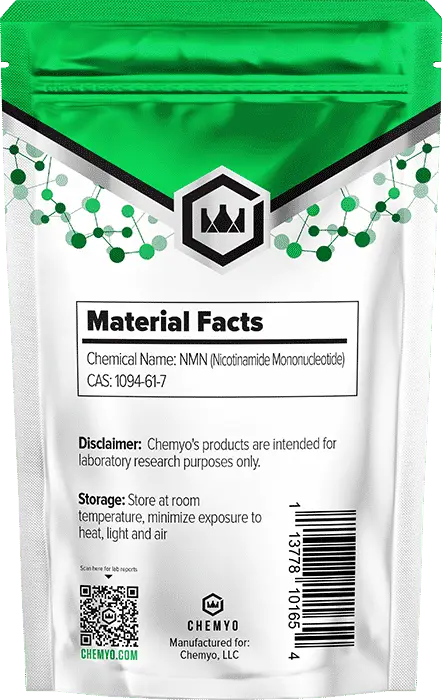
| CAS | 1094-61-7 |
| Molar Mass | 334.22 g/mol |
| Chemical Formula | C11H15N2O8P |
| Synonyms | NMN, Nicotinamide mononucleotide, Beta-NMN |
| Storage | Store at -20°C for long-term. Stable at 4°C for short-term use. Keep away from light. |
| Terms | For laboratory research use only. Not for human or animal consumption. |
What Is NMN?
Nicotinamide Mononucleotide (NMN) is a naturally occurring NAD+ (nicotinamide adenine dinucleotide) biosynthesis precursor found in trace quantities in foods including broccoli, cabbage, and avocado. It serves as a direct substrate for NMN adenylyltransferase (NMNAT), the enzyme that catalyzes the final step of NAD+ biosynthesis from the salvage pathway. NAD+ is a fundamental coenzyme in cellular redox reactions, ATP production, and crucially, the activation of sirtuins (SIRT1–7) and PARP enzymes that regulate aging-associated processes including DNA repair, mitochondrial function, gene expression, and inflammatory signaling.
NMN research has been significantly propelled by studies in aging mice showing that NMN supplementation can restore youthful metabolic function, improve insulin sensitivity, increase physical activity, and extend healthy lifespan. David Sinclair’s Harvard lab has published landmark studies demonstrating NMN’s role in vascular aging reversal and muscle function restoration in aged mice — spurring intense research interest globally.
Mechanism: The NAD+ Salvage Pathway
As animals age, intracellular NAD+ levels decline substantially — by 50% or more by middle age in some tissues. NMN replenishes these levels by bypassing the rate-limiting NAMPT-dependent step in the salvage pathway (or via the recently discovered Slc12a8 NMN transporter in gut epithelium), rapidly raising cellular NAD+ and activating downstream SIRT1-mediated deacetylation of metabolic regulatory proteins including PGC-1α, FOXOs, and HIF-1α.
Research Applications
- Aging biology: Hallmarks of aging including mitochondrial dysfunction, genomic instability, and cellular senescence.
- Metabolic disease: Insulin sensitivity, obesity, liver metabolism in high-fat diet and diabetic mouse models.
- Vascular aging: Endothelial function, angiogenesis, and muscle blood flow restoration in aged animals.
- NAD+/NNMT axis: Study alongside 5-AMINO-1MQ for complementary NAD+ metabolism research.
Related Products
Complementary NAD+ axis compound: 5-AMINO-1MQ Suspension. Metabolic comparators: GW501516, SR9009. For laboratory research use only.
Reviews
There are no reviews yet.