
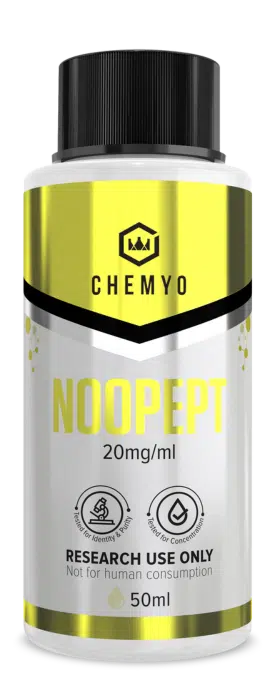
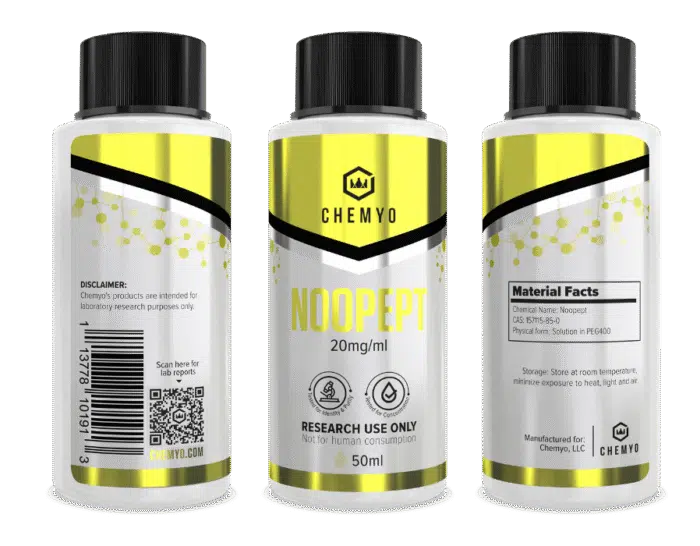

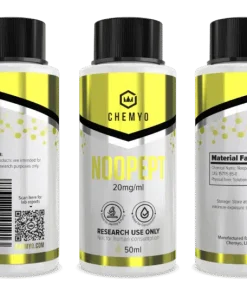
Noopept Solution 20mg/ml – 50ml
| Application | Peptide-derived nootropic / Cognitive research compound |
| Concentration | 2% (20mg/ml) |
| Composition | 98% PEG 400, 2% Noopept (>99% purity) |
| CAS | 157115-85-0 |
| Molar Mass | 320.38 g/mol |
| Chemical Formula | C17H22N2O4 |
| Synonyms | Noopept, GVS-111, N-Phenylacetyl-L-prolylglycine ethyl ester |
| Storage | Minimize open air exposure, store in a cool dry place |
| Terms | For laboratory research use only. Not for human or animal consumption. |
What Is Noopept?
Noopept (GVS-111, N-Phenylacetyl-L-prolylglycine ethyl ester) is a synthetic dipeptide-derived nootropic compound developed in Russia and studied primarily for cognitive enhancement, neuroprotection, and memory improvement. It is structurally derived from the endogenous neuropeptide cycloprolylglycine and acts as a prodrug that is hydrolyzed in vivo to release its active metabolites. Per unit mass, Noopept is reported to be approximately 1,000 times more potent than piracetam in rodent cognition assays — with effective doses in animal studies typically in the microgram-per-kilogram range.
Unlike stimulant-type cognitive compounds, Noopept exerts its effects primarily through modulation of glutamate receptor signaling (AMPA and NMDA) and upregulation of neurotrophic factors (BDNF and NGF) in the hippocampus. It does not produce CNS stimulation, is not a monoamine-active compound, and has not been associated with dependence or tolerance in animal models.
Mechanism of Action
Noopept’s primary metabolite, cycloprolylglycine, acts as a positive allosteric modulator at AMPA receptors and enhances NMDA receptor-mediated calcium signaling. It also upregulates BDNF and NGF mRNA expression in hippocampal and cortical neurons — effects that underlie its memory-consolidating and neuroprotective properties. Its rapid oral absorption (peak plasma levels at 10–15 minutes in rodents) and short half-life make it well-suited for acute dosing protocols in cognitive challenge study designs.
Research Applications
- Memory consolidation: Reverses amnesia induced by scopolamine and other anticholinergic agents in rodent models.
- Neuroprotection: Protects against oxidative stress-induced neuronal damage; studied in TBI and Alzheimer’s models.
- Anxiety: Anxiolytic effects observed at low doses in open-field and elevated plus-maze models.
- Cognitive enhancement: Improved spatial memory, recognition memory, and learning in normal and impaired rodent subjects.
Related Research Compounds
Noopept is frequently studied alongside other cognitive research compounds. NSI-189 targets hippocampal neurogenesis — a structural, long-term mechanism vs Noopept’s acute receptor modulation. CDP-Choline provides cholinergic support. Sunifiram and Unifiram are more potent AMPAkines with related glutamatergic mechanisms. Also available: Noopept Powder (10g).
Read our guide: Noopept Research Guide: Mechanism, Cognitive Effects & Comparisons.
For laboratory research use only. Not for human or animal consumption.







Reviews
There are no reviews yet.