
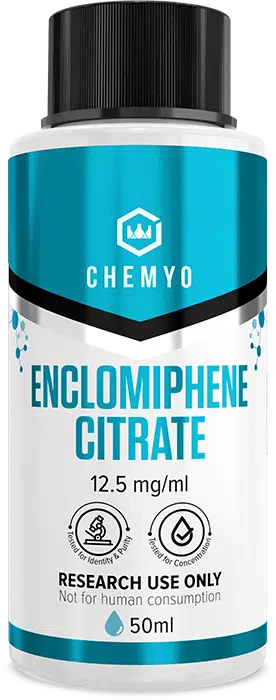

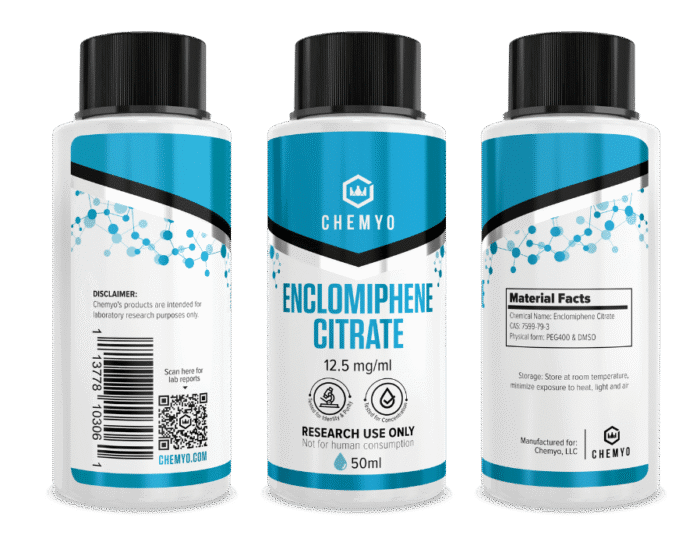

Enclomiphene Citrate Solution 12.5mg/ml – 50ml
| Application | Selective Estrogen Receptor Modulator (SERM) |
| Concentration | 12.5 mg/mL |
| Composition | PEG 400, DMSO (10%) |
| Appearance | Clear, colorless to faint yellow solution |
| CAS | 7599-79-3 |
| Molar Mass | 598.08 g/mol |
| Chemical Formula | C32H36ClNO8 |
| Synonyms | Enclomiphene Citrate, trans-Clomiphene Citrate |
| Storage | Store at 20–25°C. Minimize air exposure. Protect from light and moisture. |
| Terms | For laboratory research use only. Not for human or animal consumption. |
What Is Enclomiphene Citrate?
Enclomiphene citrate is the trans-isomer of clomiphene and a selective estrogen receptor modulator (SERM) that acts as an estrogen receptor antagonist at the hypothalamic level. By blocking negative feedback on the hypothalamic-pituitary-gonadal (HPG) axis, enclomiphene increases the pulsatile release of luteinizing hormone (LH) and follicle-stimulating hormone (FSH), which in turn stimulates testicular testosterone production. This mechanism distinguishes it from testosterone replacement therapy (TRT), which suppresses the HPG axis.
Enclomiphene has been studied in multiple Phase 2 and Phase 3 clinical trials for secondary male hypogonadism, where it demonstrated the ability to restore normal testosterone levels while maintaining or improving sperm counts — a meaningful clinical advantage over TRT for men who wish to preserve fertility.
Mechanism: HPG Axis Restoration
Clomiphene consists of two isomers: the cis-isomer (zuclomiphene) has weak estrogenic agonist activity, while the trans-isomer (enclomiphene) is the pharmacologically active antagonist component. By isolating enclomiphene from the racemic mixture, researchers have access to a cleaner pharmacological tool for studying hypothalamic estrogen receptor antagonism and its downstream effects on the reproductive endocrine axis.
Research Applications
- Secondary hypogonadism: Restoration of endogenous testosterone via HPG axis stimulation.
- Male fertility: Unlike TRT, enclomiphene typically increases or maintains sperm count while elevating testosterone.
- Endocrinology: Research into estrogen receptor subtypes in the hypothalamus and their role in HPG axis regulation.
- Comparative SERM pharmacology: Studies examining the differences between enclomiphene, tamoxifen, and other SERMs in central versus peripheral ER activity.
Related Compounds
Enclomiphene is studied alongside RAD-140 (Testolone) and LGD-4033 in research designs examining testosterone axis modulation from different angles — SARMs directly activate the androgen receptor while enclomiphene stimulates endogenous androgen production via the HPG axis. For reference on the most studied SARM in clinical settings, see MK-2866 (Ostarine).
Note: Supplied in HDPE bottle due to DMSO solvent compatibility. Filled content is 50 mL for all units.
For laboratory research use only. Not for human or animal consumption.






Reviews
There are no reviews yet.