
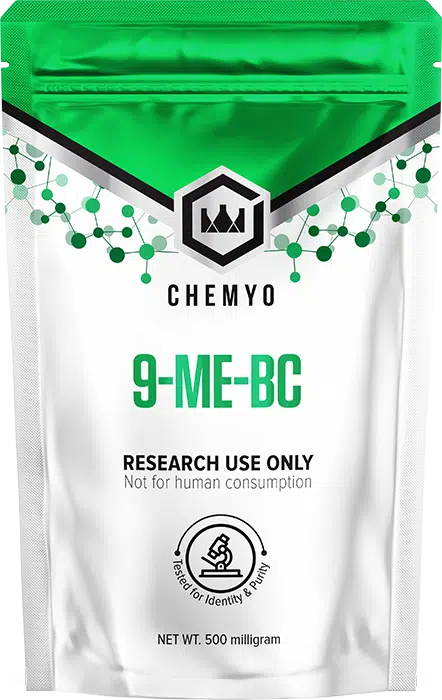
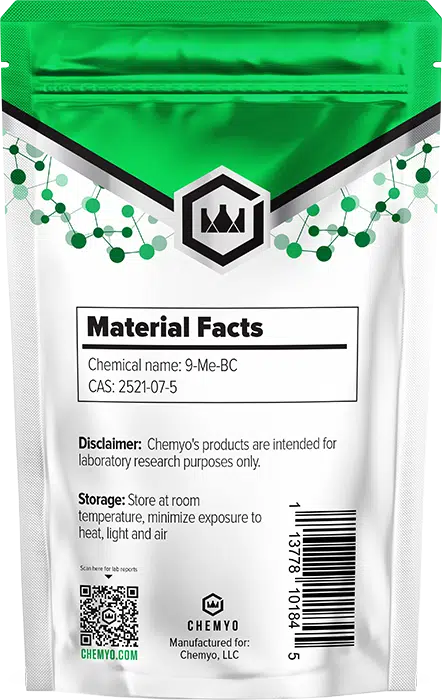

9-ME-BC Powder – 500mg
| Application | Dopaminergic neuroregeneration / MAO inhibitor |
| Purity | >99% (third-party verified) |
| Amount | 500 mg |
| CAS | 2521-07-5 |
| Molar Mass | 196.25 g/mol |
| Chemical Formula | C12H12N2 |
| Synonyms | 9-methyl-beta-carboline, 9-MBC |
| Storage | Store at 4°C or below, protected from light. Minimize air exposure. |
| Terms | For laboratory research use only. Not for human or animal consumption. |
What Is 9-ME-BC?
9-Methyl-beta-carboline (9-ME-BC) is a dopaminergic neuroregeneration compound from the beta-carboline alkaloid family, investigated for its ability to stimulate the growth and recovery of dopaminergic neurons while simultaneously inhibiting monoamine oxidase (MAO) enzymes. Unlike conventional MAO inhibitors used in psychiatric medicine, 9-ME-BC’s proposed primary mechanism is not simply preventing dopamine degradation but actively upregulating the expression of neurotrophic factors (BDNF, GDNF) and promoting dopaminergic neuronal proliferation — making it a uniquely positioned tool for Parkinson’s disease research and dopaminergic system neuroscience.
9-ME-BC has been shown in rat models to increase dopamine synthesis enzymes (tyrosine hydroxylase, DOPA decarboxylase) in surviving dopaminergic neurons, enhance dendritic complexity of dopamine-producing cells in the substantia nigra, and improve spatial learning and memory. The compound crosses the blood-brain barrier and shows particular selectivity for the mesolimbic and nigrostriatal dopaminergic pathways.
Mechanism of Action
9-ME-BC inhibits MAO-A and MAO-B (predominantly MAO-A), reducing dopamine catabolism. It also upregulates GDNF and BDNF expression in dopaminergic neurons, promotes dendritic arborization, and may modulate NMDA receptor function. These combined neuroprotective and neuroregenerative effects are studied in models of dopaminergic neurotoxicity (6-OHDA and MPTP models) as well as normal aging-associated dopaminergic decline.
Research Applications
- Parkinson’s disease models: Neuroprotection and neuroregeneration in 6-OHDA and MPTP dopaminergic toxicity paradigms.
- Dopaminergic neurotrophic factor expression: GDNF and BDNF upregulation in substantia nigra neurons.
- Cognitive enhancement: Spatial learning, memory consolidation, and hippocampal plasticity via dopaminergic modulation.
- MAO inhibition studies: Enzyme kinetics and catecholamine metabolism research.
Related Products
Dopaminergic research pair: Bromantane Solution (dopamine biosynthesis upregulator — different mechanism, complementary endpoint). Neurogenic compound: NSI-189 (serotonergic/hippocampal neurogenesis). For laboratory research use only.
Reviews
There are no reviews yet.